

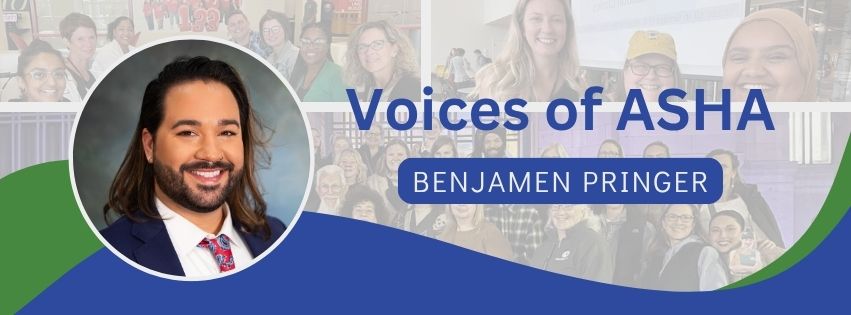
What Keeps Ben Pringer Coming Back to ASHA's Annual School Health Conference
The adolescent and school health program manager has returned to ASHA’s annual conference every year since his first one. Pringer explains how its interdisciplinary approach to youth health, welcoming community, and practical ideas keep him coming back.
By the time Ben Pringer boards his flight home from ASHA’s Annual School Health Conference, he’s already thinking ahead.
“I always leave the conference with my mind reeling in the best way: thinking about what I can bring back to my team, who I need to follow up with, and what we might be able to accomplish,” he says.
After five years of attending the conference, Pringer has come to expect that feeling. He has attended every ASHA conference since joining the association and even builds conference attendance into one of his grant budgets because he considers it an essential investment in his work. Like any national conference, attending takes planning, time and budget, but Pringer says the ideas, relationships and renewed energy he brings home make the commitment worthwhile.
And, the value extends well beyond a week at the conference. Each conference gives Pringer new ideas, new relationships, and new momentum he carries back to Missouri.
Where Youth Health Education Comes Together
As Adolescent and School Health Program Manager for the Missouri Department of Health and Senior Services, Pringer’s work spans multiple areas of school and adolescent health. No single discipline has all the answers, which is why he values a conference that brings educators, school nurses, public health professionals and other youth health leaders together to learn from one another.
Helping young people build healthy habits is what motivates that work. “The more we can work with youth and help them develop healthy habits now, the more we set them up for success in the future,” Pringer says.
While many conferences concentrate on a single subject area, ASHA offers sessions on adolescent health, school nursing, chronic condition management, nutrition, physical activity, and other topics, reflecting the interconnected nature of the work itself. That interdisciplinary perspective helps attendees see how challenges in one area of youth health often connect with solutions in another.
“ASHA is unique because it provides such a wide variety of topics and really sees the big picture of how all these different pieces align to support youth,” Pringer says.
Each year, he returns home with new professional connections and renewed energy to support youth across Missouri. “There are a lot of conferences on school health,” he says, “but it’s not very often you find conferences that cover all those different topics and bring it all together in one week of learning.”
For Pringer, that combination of interdisciplinary learning and practical ideas is only part of what makes the conference valuable. The other part is the sense of connection ASHA creates once attendees are in the room together.

A Conference That Feels Like Community
Attending his first ASHA School Health Conference alone after the COVID-19 pandemic, Pringer wasn’t sure what to expect. Instead of navigating the conference on his own, he quickly found himself sharing rides with other attendees and meeting professionals between sessions. The conference’s size and format made those interactions feel natural, helping him build relationships almost from the moment he arrived.
“My first ASHA conference was scary, but it was also a pleasant surprise,” he says. “I went by myself, and I didn’t know anyone, but I left with so many good contacts.”
The experience also changed Pringer’s perception of what a national conference could feel like.
“What makes ASHA different is that even though it is a national conference, there is this warm, comfortable sense that we are all there under the same guided purpose,” he says. “Regardless of how long you have been in the field, what agency you come from, or what your background is, everyone feels like they are on the same playing field.”
Learning That Continues Beyond the Conference
The conference builds opportunities for conversation into the learning experience. Roundtable seating, interactive sessions, and opportunities for discussion make it easy to exchange ideas with fellow attendees and presenters alike.
“I don’t know that I ever go to a session where it’s just what I would call a ‘sit and get,'” he says. “There’s always interaction with the audience and the presenter, interaction amongst audience members. There’s always something going on.”
Many of those conversations grow into ongoing professional relationships. Pringer regularly follows up with presenters and fellow attendees to exchange ideas and resources he can adapt for his work in Missouri.
One conversation from last year’s conference has stayed with him. During a session on adolescent health, a presenter shared practical resources in a way that respected the different communities and perspectives represented in the room. Afterward, Pringer reached out, and the presenter shared additional resources he could bring back and adapt for his work in Missouri.
“It didn’t come down to your views on things versus my view on things,” Pringer says. “It came down to, this is the education, this is how we can support youth.”
He adds, “I always learn something new. I always get something from the presenters. And I always meet somebody that I hadn’t known before.”
There’s a Place for Everyone
Back in Missouri, Pringer shares new ideas and resources with colleagues while following up with presenters and other attendees. Some ideas become resources he shares with colleagues. Others shape programs and initiatives that support schools and young people across Missouri. He also starts planning how to adapt what he learned before reconnecting with many of those same professionals the following year.
Knowing he’ll be seeing many of those same people again the following year, he hopes to show them the impact their ideas had back home. “I’m very big on giving credit where credit is due,” he says. “I always want to go back and be able to let those people know that they had an influence on me and that they had an influence on the overall youth health of Missouri.”
Pringer believes anyone who works with youth can benefit from the conference. “You will get something out of it, and you will be able to bring something back,” he says. “If you work in a school or you work with youth, there is a place for you at this conference.”
Ben’s experience shows what school health professionals can gain when they come together across disciplines.
Explore ASHA’s 100th Annual School Health Conference and see what you could bring back to your own work.
